Gazundering: what it is, and what to do when your buyer lowers their offer
A late price cut is legal until contracts are exchanged. Whether to accept it depends on the reason behind it and on what starting again would cost you.
On this page
The short answer
Gazundering is when a buyer lowers an agreed offer late in a house sale, often just before exchange of contracts. In England and Wales it is legal, because an offer is not binding until contracts are exchanged.1 You can accept the cut, negotiate, or refuse and put the home back on the market.
A late cut puts you on the spot, but the decision rests on three things you can check: whether a real defect lies behind it, what it costs against starting again, and whether the buyer would actually walk away.
What is gazundering?
Gazundering is a buyer demanding a lower price after the seller has accepted their offer, counting on the seller to agree rather than start again. Jowitt's Dictionary of English Law, quoted in a Northern Ireland Assembly briefing, describes a purchaser who "strategically demands a reduction in price".8 In plain terms, the meaning of gazundered is a seller whose agreed price has been cut this way.
It can happen at any point before exchange. In a 2023 survey of recent sellers for House Buyer Bureau, the reasons buyers gave most often were their survey and a lender's down valuation.11 Some cuts arrive the day before exchange, when a seller has the most to lose. The BBC reported one seller whose buyers dropped their offer by £15,000 at that point.12
Is gazundering legal?
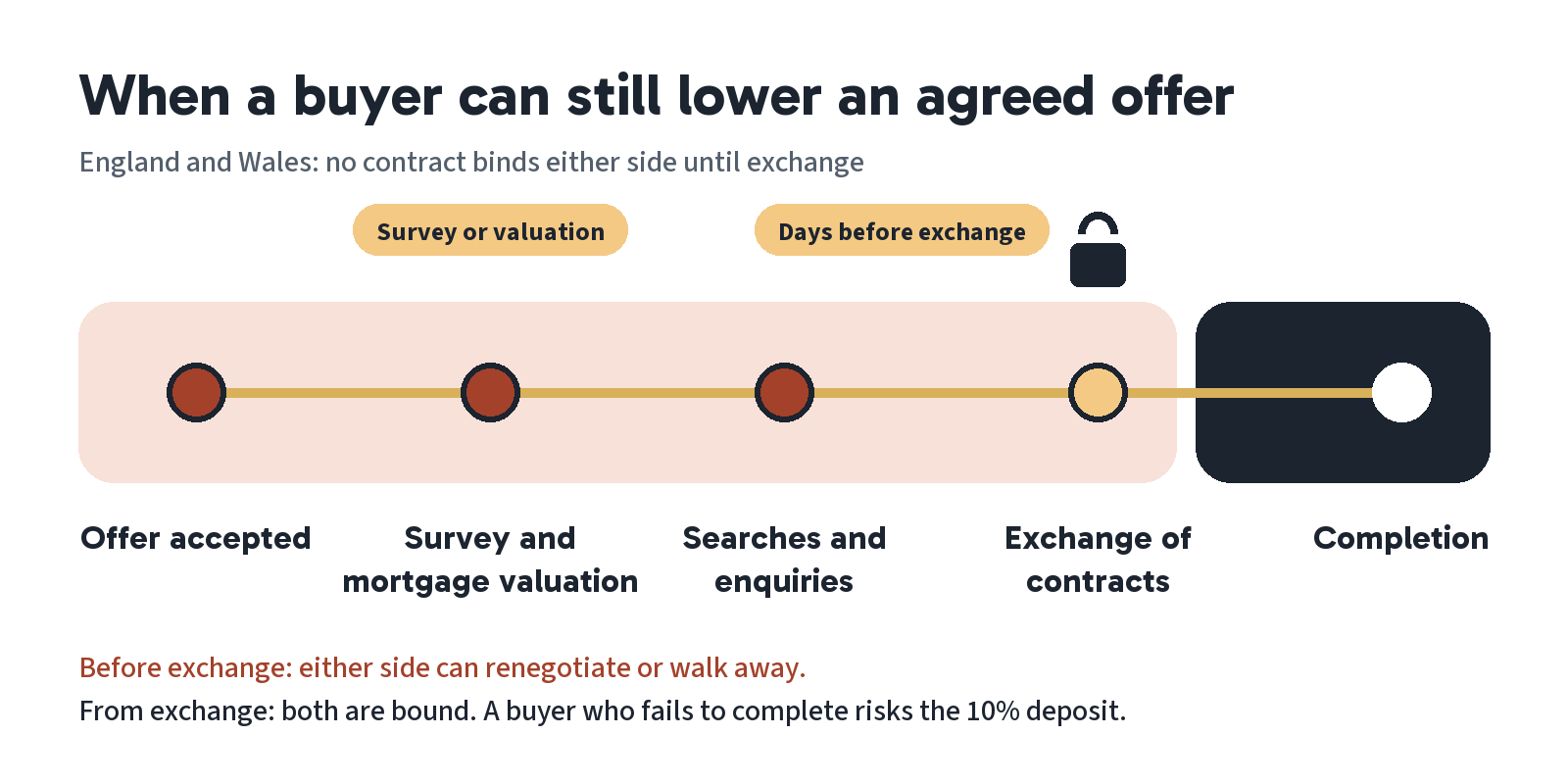
Yes, in England and Wales, until contracts are exchanged. A contract to sell land only exists in writing, signed by both sides, and GOV.UK states that an offer is not legally binding until contracts are exchanged.21 Until then the buyer can lower their offer, and you can refuse it, take another buyer or withdraw, without either side owing the other anything under the sale.
Exchange changes that. From exchange the agreement is legally binding, and neither side can usually pull out without paying compensation.3 Under the Law Society's Standard Conditions of Sale, which most residential contracts use, the buyer pays a 10 per cent deposit at exchange. If they then fail to complete after a notice to complete, you can rescind the contract, keep the deposit and claim your losses.4
Is gazundering legal in Scotland?
Gazundering is possible in Scotland, but only before missives are concluded. Scottish sales are agreed through formal letters between solicitors called missives, and once they are concluded both sides have a binding contract.5
The Law Society of Scotland also sets a rule for buyers' solicitors. If a client wants to lower an accepted price, and the offer was not made subject to a survey, a valuation or finance, the solicitor should stop acting for them. Where the offer was subject to survey, adjusting the price for a problem the survey found is allowed. Wanting a lower price is not a good reason in itself.6 The UK government's consultation links Scotland's earlier binding stage to its lower fall-through rate, 9 per cent of transactions.7
Northern Ireland
Northern Ireland works like England and Wales on this point. A Northern Ireland Assembly briefing in 2013 found that gazundering was not illegal there, because a property contract must be evidenced in writing and either side can withdraw until it is signed.8 We found no later official statement that changes it.
What is the difference between gazumping and gazundering?
Gazumping is the seller's version, where a seller who has accepted one offer drops that buyer for a higher offer before exchange. Gazundering is the buyer's version, where the buyer cuts the price they agreed. Both are possible because nothing binds before exchange.8
Gazundering and gazumping side by side
How common is gazundering?
No official body counts it. The figures published come from companies that buy houses for cash, measured in different ways, so read them as a rough guide from firms with an interest in the subject.
| Published by | Date | What it measured | Figure |
|---|---|---|---|
| Quick Move Now, reported by Property Reporter | February 2025 | Sales with an attempted renegotiation after the sale was agreed. No method or sample stated | 19% of sales; the seller accepted the cut in 56% of attempts9 |
| Quick Move Now | January 2026 | Reasons for sales that fell through in 2025. Basis not stated | 13% of failed sales followed an unsuccessful attempt to lower the price10 |
| House Buyer Bureau, survey run by Find Out Now | February 2023 | 1,104 people who had sold in the previous six months | 31% said their buyer lowered the offer; 75% of those accepted11 |
Quick Move Now and House Buyer Bureau buy houses for cash. The three figures measure different things and should not be compared with each other.
The Conveyancing Association told BBC Radio 4's Money Box in July 2026 that gazundering is small but growing, because the market has turned in buyers' favour.12 In September 2026 Rightmove found more homes for sale than in the same month of any of the last 12 years, while buyer enquiries were down 9 per cent on a year earlier.13 With that much choice, a buyer has less to lose by asking.
Gazundering after a survey: when is a lower price fair?
A lower price is fair when it rests on evidence the buyer can show you and did not have when they offered. That means a defect in their survey report, a lender's valuation below the price, or a problem in the searches. RICS, which sets the standard for home surveys, says a buyer can renegotiate the price to reflect the cost of necessary repairs a survey finds.14
A mortgage valuation is different. It is done for the lender, not the buyer, and it is not a survey of the house's condition.14 When it comes in below the agreed price, the lender may lend less, and the buyer's usual first move is to ask you to renegotiate.15 How to answer a low valuation with sold prices is in our guide to a down valuation.
A cut you can check, and a cut that tests you
If your buyer is a house-buying company that belongs to The Property Ombudsman scheme, its code says it should not reduce an offer late without a valid reason, fully explained to you in writing.16
How to deal with gazundering
Treat it as a negotiation, not an ultimatum. Get the reason and the evidence in writing, put a figure on what refusing would cost you, then accept, counter or refuse, and decide whether the house goes back on the market while you talk.
- 01 Ask for the reason in writing Ask your agent to get the buyer’s reason in writing, with the page of any survey or valuation it relies on. Your agent must pass on every offer, including a lower or conditional one, promptly and in writing.17
- 02 Check it Set the reason against what you know about the house. For a repair, get a quote of your own. For a valuation, look at what similar homes nearby actually sold for.
- 03 Put a figure on starting again Add up what a new buyer would cost: months back on the market, legal work done again, and the risk to any home you are buying.
- 04 Accept, counter or refuse You can counter at a price between the two. If you refuse, say so plainly and say which price stands.
- 05 Tell your agent whether to keep marketing Until exchange you can keep the house on the market. Agents in The Property Ombudsman scheme must take your instructions on this once an offer is accepted.18
What starting again can cost
As an illustration, on a £250,000 sale a £10,000 cut is 4 per cent of the price. Refusing it, if the buyer walks, puts you back at the start of a search that has taken 82 days on average in 2026 so far, before the legal work begins again. A cut that small against that wait is often worth negotiating rather than refusing outright. A cut with no reason behind it is still worth testing first.
Ask to see the page of the survey or report the buyer is relying on, and price that problem yourself with a contractor's quote. A cut close to that figure is a point the next buyer would raise too, so it is worth settling. If nobody can show you a reason, tell your agent in writing to keep the house on the market, and answer the buyer only once you know whether anyone else is interested.
 Haroon Ali Author, The House Desk. Over 11 years in property and renovation
Should you accept the lower offer?
- Is there a specific reason you can check, such as a survey defect or a down valuation?
- Yes Is the cut close to the real cost, such as your repair quote or the valuation gap?
- Yes Settle around the real cost A cut backed by evidence will meet the next buyer too. Agree near your own quote.
- No Counter with the real figure Offer the cost of the problem, show your quote, and hold there.
- No Would losing this buyer cost you more than the cut?
- Yes Counter, and keep marketing Offer part of the cut if you must, and ask your agent to keep showing the house until exchange.
- No Refuse, and relist if they walk Hold your price. A buyer testing you may come back. If not, the house is back on the market. If the sale falls through
How to avoid gazundering
You cannot stop a buyer asking before exchange, but you can leave less room for it. Be ready to exchange quickly, disclose problems up front, check the buyer can proceed, and keep a fallback until contracts are signed.
- Instruct a solicitor before you accept an offer, so the searches, title documents and property forms are ready. The Conveyancing Association's advice, reported by the BBC, is that less time before exchange gives less chance to gazunder.12
- Answer the property information form fully and disclose known defects early, so a survey tells the buyer little they did not already know.22
- Ask your agent how the buyer's ability to proceed was checked. Agents in The Property Ombudsman scheme must keep checking it until exchange.18
- Keep the house on the market until exchange if you want a fallback, and tell your agent so in writing.18
- Ask your solicitor about a reservation agreement, under which the buyer pays a fee they lose if they withdraw. How they work, and what they ask of you, is in protecting the next sale.
Will the law stop gazundering?
Not yet. The government plans to make sales binding much earlier, with a financial penalty for pulling out without a valid reason. That only happens once upfront sales packs are in place, and the legislation is planned for the end of this Parliament.24
The government's plans, as published
- June 2026 Reform roadmap23 Binding conditional contracts to be required once sales packs are embedded. Voluntary reservation agreements promoted until then.
- July 2026 Statement to the BBC12 The ministry said it is stopping gazundering through legally binding agreements, with fines for buyers who walk away without a valid reason.
- Later in 2026 Code of Practice for property agents24 Minimum standards for agents, announced as the first step.
- By the end of this Parliament Legislation24 Sales packs, binding contracts and digital systems.
Questions people ask about gazundering
Can I keep my house on the market after accepting an offer?
Yes, until contracts are exchanged. Tell your agent in writing. Agents in The Property Ombudsman scheme must ask whether you want the house withdrawn or kept on the market once you accept an offer, and act on your answer. Keeping it on the market gives you a fallback if the buyer later cuts the price.
Do I have to accept a lower offer after a survey?
No. Until exchange you can accept, counter or refuse. If the survey found a real defect, the next buyer’s surveyor may find it too, so a cut close to the repair cost can be worth settling. A cut well above any cost is a negotiating position, and you can say no.
Find the route that fits you
Three questions, about 30 seconds. Your answers stay in your browser.
Question 1 of 3
Your best fit
What you give up:
Why this route
Close second: Property auction.
Selling in Scotland works differently, with a Home Report and offers over a closing date. The guides note where Scottish rules differ.
Get help with your sale
Leave your details and tell us how you would like to sell.
While you wait, the guide covers what to check before you agree to anything.
Sources
(24)
Numbers in the text link to these. Each was read on the date shown. How we research
- Selling a home: offers and negotiations
- Law of Property (Miscellaneous Provisions) Act 1989, section 2
- Selling a home: transferring ownership (conveyancing)
- Standard Conditions of Sale (5th edition, 2018 revision), with specimen conditions
- Making an offer on a property
- Gazumping, gazundering and closing dates (rules and guidance, section F, division C)
- Home buying and selling reform: consultation document
- Gazumping and gazundering in Northern Ireland (Research and Information Service briefing note 65/13)
- One in five property sales now experience 'gazundering'
- 26% of property sales fell through before completion in 2025
- Almost a third of UK homeowners say they have been gazundered
- 'My buyers dropped their offer by £15,000 the day before exchange': Gazundering and how to avoid it
- Rightmove House Price Index, September 2026
- House surveys (UK): the costs, types and benefits of an RICS Home Survey
- Mortgage valuations explained
- Code of Practice for Residential Property Buying Companies (TPOE7-6, March 2026 issue)
- The Estate Agents (Undesirable Practices) (No. 2) Order 1991, Schedule 3
- Code of Practice for Residential Estate Agents (TPOE27-9, March 2026 issue)
- Estate agent fees for selling your house
- TwentyCi and TwentyEA Property and Homemover Report, Q1 2026
- Conveyancing Costs Index Q2 2026
- TA6 Property information form (6th edition) (2025)
- Home buying and selling reform roadmap
- Homebuying shake-up to slash delays, cut costs and stop sales falling through