Should I sell my house or rent it out?
Letting can pay, but only on sums that survive tax, empty months and repairs. Since May 2026 it is also much harder to undo in England.
On this page
The short answer
The answer to "should I sell my house or rent it out" turns on one test: does the rent cover the mortgage, letting costs and tax with room to spare? Letting also needs your lender's permission.1 In England since 1 May 2026, a tenancy rolls on until you give notice on a legal ground, so letting is far harder to undo than a sale.2
The question usually comes with a move, for a job, a partner or a bigger place, when keeping the old house feels like the safer choice. Run the figures first. Then weigh what a landlord takes on, and what a sale ends.
Is it worth renting out my house?
Renting out your house is worth it when the rent left after every cost and the tax is enough to pay you for the work and the risk. The rent has to cover mortgage interest, a letting agent if you use one, insurance, safety checks, repairs and the months with no tenant, and income tax is charged on the rent before the mortgage interest is taken off.9
The market a landlord would be letting into
- £1,459 Average monthly rent in England, August 2026, up 4.0 per cent on a year4
- £293,479 Average house price in England, July 2026, up 1.1 per cent on a year5
- 15 to 20% Of the monthly rent, a typical fee for a fully managed letting service6
The fee figure comes from Propertymark, the trade body for letting agents, and Which? gives the same range for full management, with finding a tenant alone at 10 per cent of the rent or more.7 Neither says whether VAT is included, so ask any agent you talk to.
Rent vs sell calculator: what a year of letting leaves you
Enter your own figures. The rent should come from listings for similar homes nearby or from letting agents, not from a hope. The calculator works out one year at this year's tax rates and shows whether the house pays for itself.
Enter the rent to see what a year of letting leaves you.
| Rent received, after empty weeks | |
|---|---|
| Letting agent's fees | |
| Other running costs | |
| Mortgage interest | |
| Income tax on the rent, after the interest credit | |
| Left after tax | |
| Capital repaid | |
| Cash left after capital repayments |
Tax is worked on the profit before mortgage interest, at your rate, then reduced by 20 per cent of the interest.9 Rates are those for England, Wales and Northern Ireland.10 It treats the rent as taxed wholly at the rate you pick, and leaves out your personal allowance, losses from earlier years and Scottish rates. Capital repaid is not a cost for tax, but it is money you pay out.
As an illustration, a house let at £1,000 a month, empty for two weeks a year, with a 15 per cent agent, £1,800 a year of other costs and a mortgage costing £400 a month in interest and £200 in capital, leaves a basic rate taxpayer about £14 a month. The same house leaves a higher rate taxpayer about £120 a month short. The difference is the tax on rent before interest, worked out in the next section. Run it with your own numbers.
What tax do I pay if I rent out my house?
You pay income tax on the rental profit at your own rate: 20, 40 or 45 per cent in England, Wales and Northern Ireland for 2026 to 2027.10 Letting agent fees, repairs, maintenance and landlord insurance come off the rent first.8 Mortgage interest does not. Since April 2020 it earns a tax reduction at the basic rate instead, worth 20 per cent of the interest.9
For a basic rate taxpayer, the credit roughly cancels the tax on rent spent on interest. A higher rate taxpayer pays 40 per cent on rent that is spent on interest and gets 20 per cent back, which is why a mortgaged house can show a profit for tax and still lose money. If your property income is small, the first £1,000 a year can be tax-free under the property allowance, used instead of claiming expenses.8
Moving abroad adds a step. If you live abroad for six months or more a year you are a non-resident landlord, and your letting agent or tenant takes basic rate tax off the rent unless HMRC approves you to be paid in full.12
Do I pay capital gains tax if I rent out my house?
Yes, you can pay capital gains tax when you sell a house you have let, on part of the gain. A home that was your only main home throughout is normally free of the tax when you sell it.13 Once you move out and let it, the relief shrinks. You keep it for the years you lived there plus the final 9 months of ownership.15
HMRC splits the gain by time: the years you lived there, plus those 9 months, divided by the years you owned it, with no valuation when you moved out.15 Letting relief no longer helps when the whole house is let. Since 6 April 2020 it applies only if you lived in the home at the same time as your tenants.1416
| Step | Amount |
|---|---|
| Gain, before any buying and selling costs | £100,000 |
| Relieved share: 6 years 9 months out of 10 years, 67.5 per cent | £67,500 |
| Gain left | £32,500 |
| Less the £3,000 tax-free allowance | £29,500 |
| Tax at 24 per cent, the rate above the basic rate band | £7,080 |
Rates and allowance for 2026 to 2027.17 Gains that fall within your basic rate band are taxed at 18 per cent. Selling instead of letting, in the same case, would usually mean no capital gains tax at all.
When tax is due on a UK home, you report it and pay it within 60 days of completion.18 Each extra year let adds to the taxed share.
Run the letting figures twice: once at this year's tax rates and once at the property rates due from April 2027, with your mortgage costed at whatever your lender will charge once you let. If the house only pays its way on today's figures, the margin is thin. And decide before the tenant moves in how you would get it back, because in England a tenancy now runs until you give notice on a legal ground.
 Haroon Ali Author, The House Desk. Over 11 years in property and renovation
Can I rent out my house if I have a mortgage?
Only with your lender's permission. GOV.UK says a landlord with a mortgage on the property must get permission from the lender before letting it.1 Which? says some lenders give consent to let on your current deal, and others will want you to move to a buy-to-let mortgage.7 Ask your lender for both options in writing, with the rate and any fee, before you put those figures in the calculator.
Can I rent out my house and buy another?
You can, but keeping the old house usually adds 5 per cent stamp duty on top of the normal rates for the new one in England and Northern Ireland.19 The higher rates apply if you still own your current home when the day of the new purchase ends. Sell the old main home within 3 years and you can claim the extra back, within 12 months of the sale or of the new home's tax return, whichever is later.20
Wales has its own higher rates table for buyers of an extra home, starting at 5 per cent.21 In Scotland the Additional Dwelling Supplement is 8 per cent of the whole price.22 On a £300,000 purchase in England, as an illustration, the 5 per cent surcharge adds £15,000 to the stamp duty bill. Put that beside a year of rent from the calculator.
What does a landlord have to do in England?
A landlord in England has legal duties before the tenant moves in and every year after. These are the main ones, each from the government's own guidance.
A landlord's main legal duties, England
- Gas
- A safety check on every gas appliance and flue each year, by a registered engineer23
- Electrics
- Inspected and tested at least every 5 years, with the report given to the tenant24
- Energy rating
- An EPC of E or above, unless an exemption is registered25
- Deposit
- Protected in a government-approved scheme within 30 days26
- Right to rent
- Every adult tenant checked before the tenancy starts27
- Alarms
- A smoke alarm on each storey, and a carbon monoxide alarm in any room with a fixed fuel-burning appliance other than a gas cooker28
More is coming. The government's private rented sector database opens region by region from 15 December 2026, starting in the West Midlands, with a landlord ombudsman and a Decent Homes Standard to follow.29
Can I get my house back if I rent it out?
Yes, but not quickly, and only on a legal ground. In England, section 21 "no fault" notices ended on 1 May 2026, and every private tenancy now rolls on with no end date.32 To move back in, or to sell with the house empty, you use Ground 1 or Ground 1A. The date in the notice cannot fall within the first 12 months of the tenancy, and the notice must give at least four months.3334
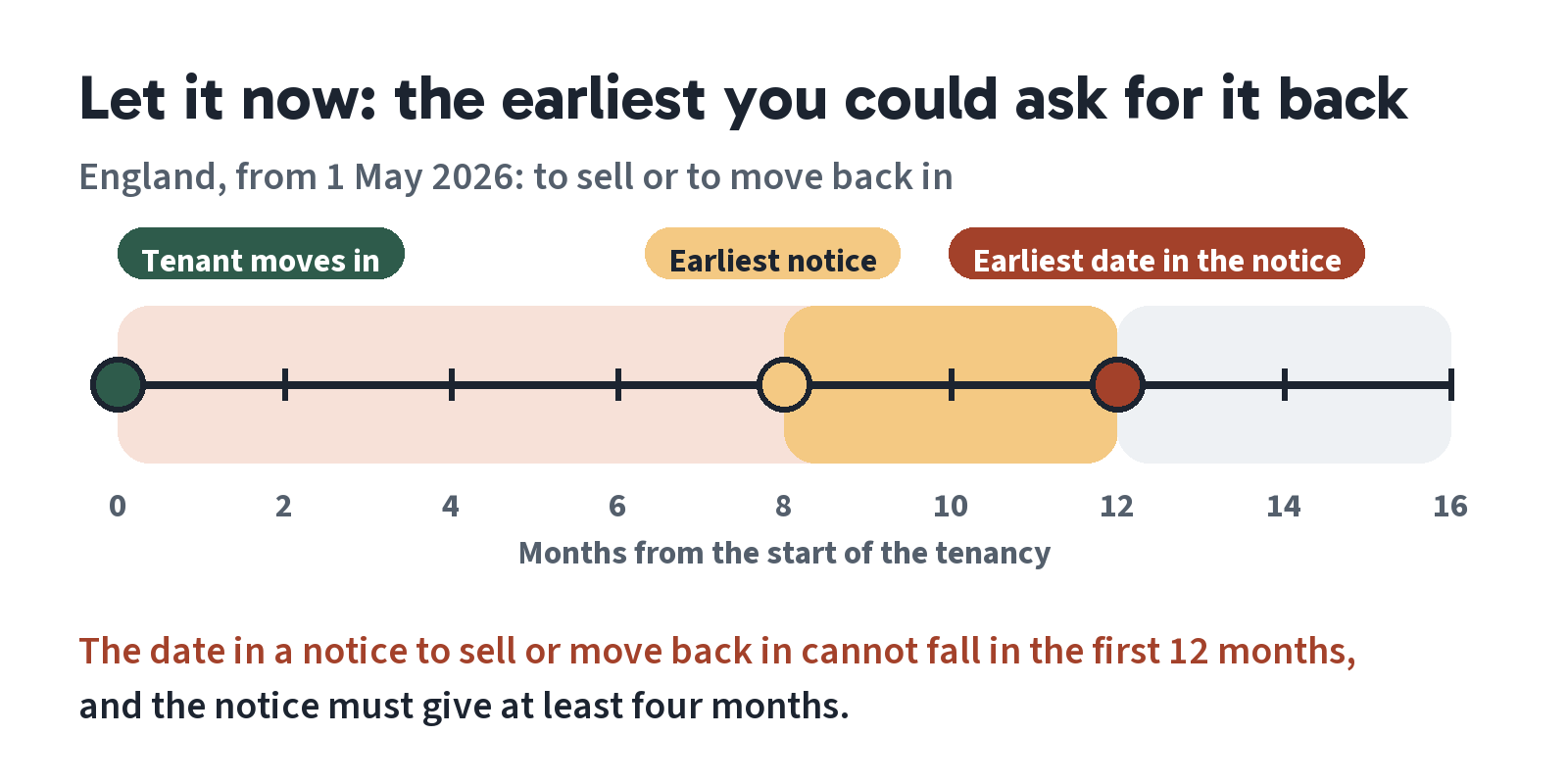
On our reading of the Act, that puts the earliest date you could ask for the house back at a year after the tenant moves in. A tenant who stays after the date in the notice can only be removed with a court order.36 If you serve notice to sell and the house does not sell, you cannot let or market it to let until 12 months after the date in the notice.35 Rent can rise once a year, with at least two months' notice.37 If you later decide to sell with the tenant still in place, or with the house empty, the routes are in selling a tenanted property.
What if I leave the house empty while I decide?
An empty house still costs you, and after a year it can cost more. Councils in England may charge up to 100 per cent extra council tax on a home empty and unfurnished for a year or more, and on a furnished second home from April 2025; each council decides.38 A home actively marketed for sale or to let is excepted for up to 12 months, so put it on the market if you mean to decide within the year.38
When renting it out makes sense, and when selling does
Renting out makes sense when the sums work at your tax rate, your lender agrees, and you are content to hold the house for years. Selling makes sense when you need the money, the margin is thin, or you may want the house back soon.
Selling and renting out, side by side
Sell or rent it out?
- With your figures in the calculator, does the house cover its costs after tax at your rate?
- Yes Has your lender agreed, and can you leave the house let for at least a year?
- Yes Renting out can work Allow for the 2027 tax rates, the extra stamp duty if you buy again, and the tax on part of the gain later. Capital gains tax later
- No Lean towards selling Without consent you cannot let, and a tenancy cannot be ended inside its first year to move back or sell. Getting the house back
- No Would you rather keep the house for its long-term value and pay the shortfall yourself?
- Yes Rent out with your eyes open Budget the yearly shortfall from the calculator, and expect the tax on the rent to rise from April 2027. Tax on the rent
- No Sell A house that does not pay its way costs you every month it stays let. Ways to sell a house
Questions people ask about selling or renting out
Can I rent out my house for 6 months?
Not as a fixed six-month let in England. Since 1 May 2026 private tenancies roll on with no end date, and the grounds for moving back in or selling cannot be used until 12 months after the tenancy started, with at least four months’ notice. Plan on a year or more before you could ask for the house back.
Should I rent or sell my house when moving abroad?
The same sums apply, with two extra points. Living abroad for six months or more a year makes you a non-resident landlord, so your agent or tenant takes basic rate tax off the rent unless HMRC approves otherwise. And you will need someone in the UK to handle the safety checks, repairs and any notice.
Find the route that fits you
Three questions, about 30 seconds. Your answers stay in your browser.
Question 1 of 3
Your best fit
What you give up:
Why this route
Close second: Property auction.
Selling in Scotland works differently, with a Home Report and offers over a closing date. The guides note where Scottish rules differ.
Get help with your sale
Leave your details and tell us how you would like to sell.
While you wait, the guide covers what to check before you agree to anything.
Sources
(38)
Numbers in the text link to these. Each was read on the date shown. How we research
- Renting out your property: landlord responsibilities
- Repossessing your privately rented property after 1 May 2026
- The Renters' Rights Act 2025 (Commencement No. 2 and Transitional and Saving Provisions) Regulations 2026 (SI 2026/421)
- Private rent and house prices, UK: September 2026
- UK House Price Index summary: July 2026
- What does a letting agent do for a landlord?
- Becoming a landlord
- Work out your rental income when you let property
- Tax relief for residential landlords: how it's worked out
- Income Tax rates and Personal Allowances
- Income Tax: Changes to tax rates for property, savings and dividend income (policy paper)
- Tax on your UK income if you live abroad: rental income
- Tax when you sell your home: Private Residence Relief
- Tax when you sell your home: if you let out part of your home
- HS283 Private Residence Relief (2026)
- CG64710: Private residence relief: letting: relief for letting of residential accommodation
- Capital Gains Tax: what you pay it on, rates and allowances
- Report and pay Capital Gains Tax: if you sold a property in the UK on or after 6 April 2020
- Stamp Duty Land Tax: Residential property rates
- Higher rates of Stamp Duty Land Tax
- Land Transaction Tax rates and bands
- The Additional Dwelling Supplement (ADS)
- Private renting: your landlord's safety responsibilities
- Electrical safety standards in the private and social rented sectors: guidance for landlords
- Domestic private rented property: minimum energy efficiency standard, landlord guidance
- Tenancy deposit protection
- Check your tenant's right to rent
- Smoke and Carbon Monoxide Alarm (Amendment) Regulations 2022: guidance for landlords and tenants
- Renting is changing: private landlords
- Rent Smart Wales
- Registering as a private landlord
- Landlord Registration Scheme
- Housing Act 1988, Schedule 2 (grounds for possession), as amended
- Housing Act 1988, section 8 (notice of proceedings for possession), as amended
- Housing Act 1988, section 16M (interpretation)
- Grounds for possession: guidance for landlords and letting agents
- Assured periodic tenancies, a guide for landlords: rent increases